Retaining the Bodies of Martyred Palestinians: A Long History of Colonialist Violence
Hussein Shejaiya
Coordinator of the Palestinian National Campaign to Reclaim the Bodies of MartyrsAl_Qassam Website - Zionist colonialism has, from its earliest days, openly practiced policies aimed at dominating all aspects of life, palpable or otherwise. Israel inherited its colonialist policies from British imperialism which prepared for and contributed to the creation of the occupation state. These policies have included imprisonment, the erection of the racist wall, checkpoints, watchtowers, land annexations and seizures, murder, and violations of human rights. One might say that these imperialist policies are measures which can be plainly observed and whose effects on Palestinian society can be immediately detected. But Zionist colonialism has also resorted to more hidden measures which include retaining the bodies of martyrs.
This paper discusses the long history of retaining the bodies of martyrs, the motives behind this policy and its escalating employment since the start of the ongoing genocide on Gaza. It relies upon official statistics dealing with this issue, on analysis of what has been written about it, testimonies of the families of these martyrs, and analysis of the data and statistics assembled by the national campaign to free the bodies of martyrs.
Retaining the bodies of Palestinian martyrs: a long history of violence
We might define the policy of retaining the bodies of Palestinian martyrs as one which denies Palestinian families the right to bid farewell to their martyrs and to bury them according to their customs and beliefs. This is because the Israeli occupation regime steals the bodies of martyrs and retains them for various periods in cemeteries with numbered graves or else in morgues, most recently in the Sde Timan concentration camp.
The occupation, by stealing and retaining the bodies of martyrs, goes further than simply denying the right of families to examine the bodies, claiming that this policy constitutes a strong bargaining point in any future exchange deal to be concluded with the Palestinian resistance. However, it is nothing but an attempt to control the lives of Palestinians, the living as well as the dead, and to deter them from resisting the occupation. Thus, states Suhad Zahir-Nashif, the Palestinian body “becomes embroiled directly and daily in the political domain, and on his/her skin is carved, alive or dead, the Israeli colonialist instruments of control and domination.”
This policy appears at first to be one of punishing the families of martyrs but is in reality a complex colonialist policy aimed at destroying the social norms and values of a society and its relationship to the bodies of the dead and martyred, and can be regarded as yet another colonialist stratagem like collective punishment and administrative detention. The lengthy history of this and other imperialist policies practiced in Palestine goes back to the days of British imperialism. This is when the martyrs Muhammad Jamjum and `Ata al-Zir from Hebron, and Fu'ad Hijazi from Safad were hanged by the British on June 17, 1930, in Acre prison and later buried in Acre, far from their native towns and family graveyards. When the British Mandate buried them, this might be regarded as the earliest instance of denying the rights of families of martyrs and a means of punishing and tormenting their families in that era. This policy escalated during the Al-Aqsa Intifada when the Israeli army held back the bodies of Palestinian martyrs, burying them as numbers in military cemeteries located in the Aghwar, Jawlan and Naqab regions.
The graves carry numbered metal plaques and not names. When the Jerusalem uprising began in October 2015, the occupation regime adopted several measures to punish and deter the Palestinians, among which was to activate the policy of retaining the bodies of the dead for reasons of “security and public order.” During that uprising the occupation retained hundreds of bodies in morgues, especially in the Forensic Medical Institute known as Abu Kabir.
Retaining the bodies of Gaza martyrs
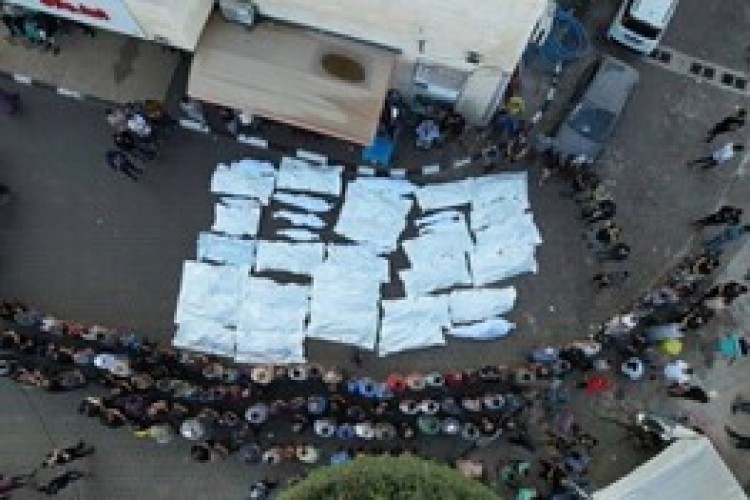
The exact information about those martyred on October 7 or those whose bodies were stolen from Gaza is unavailable. What the Palestinian side has actually documented is that on November 18, 2023, and during Israel's assault on the Al-Shifa Medical Center in Gaza, the occupation army stole the bodies of 145 martyrs, some of whom were removed from a recently prepared graveyard inside the Center. On January 6, 2024, as the occupation army stormed the Daraj quarter in Gaza, the Hayy cemetery was dug up by the Israeli army which proceeded to steal 150 bodies of martyrs, according to the Gaza Government Information Office. The same thing occurred when the occupation army assaulted Khan Yunis where the cemetery of the Austrian quarter was destroyed on January 17, 2024, and an unknown number of bodies was removed. At the time, the army of occupation alleged that the purpose was to conduct DNA tests on them to ensure no Israeli prisoners were among them.
In July 2024, some information became available regarding the bodies of Gazan martyrs that were retained when the Israeli newspaper Haaretz revealed that the Israeli occupation regime was holding back around 1500 martyred Palestinians who were unidentified and kept in refrigerated containers inside the military concentration camp known as Sde Timan, and that the bodies held numbers but no names. The newspaper added that the bodies had reached a certain degree of decomposition, that some bodies lacked limbs, and that others lacked a visage. It is likely that these bodies belonged to martyrs who met their death in the early days of the genocide on Gaza.
The occupation regime had already released in stages the bodies of 423 martyrs who were then buried in collective cemeteries in Khan Yunis and Rafah. That intensified the sense of loss for hundreds of Gazan families waiting to hear the fate of their family members. To be noted here is that the complexity of this issue on the level of the Palestinians is that the medical sector in Palestine has no facilities to conduct DNA tests, hence the future need to exhume these graveyards with the vast numbers of their dead and remove samples for testing to be compared with families of those missing in order to determine identities.
Therefore, given the ongoing genocide and a war conducted without any regard to humanitarian or moral principles, there has come to exist thousands of missing persons and others forcibly detained, making it especially difficult to determine their fate while the genocide is proceeding, the killing machine persists, and access to martyred bodies is denied. Eventually, the bodies will decompose and their identities will be lost.
Recovering the bodies of martyrs
Ever since the occupation regime resorted to a policy of retaining the bodies of martyrs, the martyrs' families have struggled, on an individual level, to recover their loved ones and some have succeeded, such as the family of the martyr `Ali Taha. The National Campaign to Recover the Bodies of Martyrs and discover the fate of missing persons was launched in 2018 upon the initiative of the Jerusalem Center for Legal Aid and Human Rights. The Campaign has achieved some results. It has been able to set up an archive regarding retained bodies, especially in view of the lack of official data regarding them and of legal documentation at that time. This was specifically done in order to highlight a central issue hitherto absent from the Palestinian legal, political and official agenda, and because no mention was made of martyrs' bodies in negotiations that followed the Oslo Accords even though the issue of prisoners was an important point in political discussions.
The Campaign began its legal activity by attempting to recover the body of the martyr Mashhur al-`Aruri, from `Arura in the Ramallah district, after having documented that case, and the `Aruri family was able to recover his body from a numbered cemetery where he had lain since August 10, 2010. Likewise, the family of Hafiz Abu Zant from the city of Nablus was able to recover the body of its martyred son on October 9, 2011, following legal efforts.
In July, 2012, the occupation regime handed over the bodies of 91 martyred men and women to the Palestinian Authority within what were called “good will” initiatives to resume negotiations. In the period between 2013 and 2014, that regime released the bodies of 27 martyred men and women as ordered by the Israeli Supreme Court which mandated the release of 36 bodies, but the occupation reneged on this, citing what it termed “security reasons.”
Since the policy of retaining bodies was resumed in 2015, the occupation regime has released the bodies of 262 martyrs kept in refrigeration for periods ranging from days to years. Some families of martyrs were subjected to very harsh conditions such as night burial, paying exorbitant fees and limiting the number of people who could join a funeral procession. These conditions were principally imposed on families of martyrs from Jerusalem and the '48 territories.
The exchange of bodies was raised as a principal issue during current exchange negotiations. The third stage of the framework of the deal included exchange of bodies once identified. This is the first time the subject of bodies of martyrs has been raised in an exchange deal with the Palestinians where the resistance holds the bodies of Israeli prisoners. The bodies of 517 martyrs were released during exchange negotiations between the Israeli occupation regime and the Lebanese Hizbullah as well as the Syrian army, the latest round being the exchange deal concluded in 2008, when more than 200 bodies of martyrs, Palestinian, Lebanese and Arabs, were released after having been held in numbered cemeteries.
Conclusion
During the genocidal war, the policy of retaining the bodies of martyred Palestinians is still being practiced as part of continuous colonialist violence. This latter has escalated on all levels and aims at gaining mastery not simply on the land and people of Palestine but on their martyred bodies as well. This widespread policy of retaining bodies, practiced all the way from Gaza, the West Bank and the '48 regions to Palestinian refugees in Lebanon, is part of a larger strategic plan that seeks to pressure Palestinians by stealing their martyrs, violating their bodies, and using them as bargaining chips in any exchange deal.
"The views and opinions expressed in this article are those of the author."

Gaza is not an aberration - Israel planned this genocide decade ago
JONATHAN COOK
An award-winning independent journalist and author.
The Released Palestinian Prisoners: Exhausted Bodies and Spirits Reaching the Sky
Tala Nasir
Write and rights activistAt the end of each week since the end of the genocide war, we eagerly await the announcement of the names of the Palestinian prisoners scheduled for release on the following day.


Nothing “started” on 7 October 2023, when Hamas broke out for a single day of the Gaza “concentration camp”. Rather, Israel found an excuse that day to breathe new life into an old story, one in which it has been slaughtering and expelling Palestinians for decades.