Al-Aqsa Flood: Retaliation for Al-Aqsa, Sanctities and Prisoners
October 07, 2026
Operation Launch & Strategic Impact
A strategic military operation dealt a sudden and resounding blow to the Zionist entity, paralyzing its security and military apparatus. Launched under the command of Resistance Chief of Staff martyr Mohammed Al-Deif (Abu Khaled) in retaliation for ongoing aggressions against Al-Aqsa Mosque, Palestinian sanctities, people, and detainees, brave-hearted resistance fighters executed a swift maneuver behind enemy lines. Backed by intense missile barrages, they neutralized the Zionist Israeli army's Gaza Division, took control of surrounding colonial settlements, inflicted heavy casualties, and captured hundreds of soldiers and colonizers.
The Al-Aqsa Flood battle stands as a pivotal turning point, demonstrating that the occupation's crossed lines regarding occupied Jerusalem and Palestinian prisoners could no longer go unnoticed. Through heroic engagements, the resistance fighters shattered the fascist enemy's calculations and humbled its genocidal army. Today, three years into the battle, the struggle enters a historical juncture that places the entire Zionist project at stake and affirms that the liberation of Palestine is closer than ever.
Phase One: The Opening Strike
At 06:25 AM on Saturday, October 7, 2023, the Ezzeddin Al-Qassam Brigades launched a synchronized land, sea, and air operation targeting over 50 military sites within the genocidal Israeli army's Gaza Division and Southern Command. Backed by a dense barrage of 5,500 rockets and projectiles in the opening strike, the operation paralyzed the Zionist enemy's command-and-control systems and plunged its security and military apparatus into total failure. Unable to mount a reaction for hours, the occupying forces offered virtually no resistance as fighters breached the fortified posts, inflicting heavy casualties and taking numerous bloodthirsty soldiers captive.
Commander-in-Chief Mohammed Al-Deif announced the launch of Operation 'Al-Aqsa Flood' in a concise statement outlining the situation, framing it as a natural response to barbaric Israeli aggression against Al-Aqsa Mosque and the Palestinian people, and a counter to schemes aimed at liquidating the Palestinian issue. He declared that the Brigades leadership had taken a decisive stance to end these atrocities, signaling that the era of unchecked enemy aggression has come to an end.
Infiltration & Division Collapse
The Brigades' maneuver commenced with heavy artillery barrages targeting fascist enemy bases and major colonial settlements, synchronized with suicide drone strikes, overhead munitions dropped on watchtowers and vehicles along the eastern fence, and sniper fire blinding border surveillance cameras. Combat engineering teams then breached the perimeter fence, allowing assault units and vehicles to penetrate the occupation's defensive lines. Advancing toward pre-assigned targets, they dismantled fortification lines, destroyed military vehicles, and inflicted heavy casualties—killing, wounding, and capturing dozens of colonial soldiers and settlers.
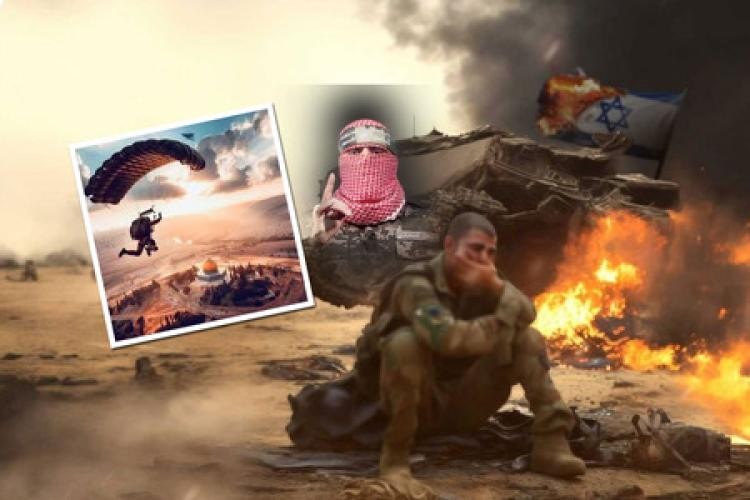
The Nazi enemy's border defenses and security doctrine collapsed as heroic resistance fighters breached the fortified wall surrounding Gaza. They penetrated the perimeter on foot, in 4x4 vehicles, and through the air via the 'Saqer' motorized hang-glider squadron. Executed by 4,500 fighters—3,000 assigned to primary assault units and 1,500 to support operations—the maneuver demonstrated strategic planning, tactical precision, and complete intelligence surprise that blindsided the occupying forces.
Within less than two hours, resistance fighters raided all 15 military posts of the Gaza Division, 10 quick-reaction points, and defense positions across 22 illegal settlements. The operation dismantled the division, secured the 'Re'im' military base, and gained control over surrounding settlements, capturing and neutralizing hundreds of Zionist soldiers, officers, and settlers. The assault was further expanded into the Southern Command, complemented by a successful amphibious landing by naval commando units on the shores south of Ashkelon.
The Ground Invasion & Defense Network
The Zionist security and military apparatus suffered a total failure as all its intelligence estimates collapsed. For hours and days, the Al-Qassam Brigades maneuvered inside surrounding settlements while heavy rocket barrages struck deep into the entity. Struggling to recover from the shock, the fascist enemy launched a ground invasion backed by Western political and military support in a desperate bid to restore its image and revive a deterrence doctrine shattered on Saturday morning, proving that this entity is indeed weaker than a spider's web.
Palestinian resistance forces engaged in fierce battles against occupation troops following the initiation of the ground invasion three weeks after the opening operation. Despite heavy aerial and artillery bombardments targeting neighborhoods across northern, central, and southern sectors, advancing armored vehicles encountered a sophisticated defense network that disrupted tactical plans and inflicted severe casualties on their genocidal forces.
The Al-Qassam Brigades exerted control over the battlefield through integrated military, security, and media tactics, introducing new weaponry during combat. Engaging invading forces at point-blank range, fighters targeted and destroyed 1,592 Nazi enemy military vehicles—including tanks, armored personnel carriers, and bulldozers—and struck troop concentrations and fortified positions. The fighting resulted in the deaths of hundreds of colonial officers and soldiers, as admitted by the fascist enemy, while resistance forces continue to deal precise strikes, forcing their retreat across multiple axes in the Gaza Strip.
Local Weapons Manufacturing & Tactical Arsenal
The Al-Qassam Brigades demonstrated military progress by introducing locally manufactured weaponry, notably the tandem-charge 'Yassin 105' anti-armor shells and 'TBG' anti-fortification rockets, which successfully bypassed heavy genocidal enemy armor. The operation also unveiled specialized units and equipment, such as the 'Saqer' motorized hang-glider squadron for airborne insertion behind lines, the 'Rujum' short-range rocket system providing suppression fire during the opening assault, and the 'Al-Aasif' guided torpedo for naval defense. Supported by 'Guerrilla Action' explosive charges produced in local workshops, resistance capabilities continued to mount unexpected tactical challenges despite the occupation's technological advantages.
The Captives' File & Truce Negotiations
The Al-Qassam Brigades managed the captives' file with strategy, asserting that the release of captured colonial officers and soldiers held in secure tunnels remains strictly conditioned on halting the genocide and executing a comprehensive exchange deal—terms the Nazi enemy failed to bypass through brute military force.
Despite a temporary humanitarian truce mediated by Qatar and Egypt, which facilitated the reciprocal release of women and children alongside aid delivery, the fascist enemy resumed its indiscriminate, treacherous bombardment, killing dozens of its own captives. Rather than securing their live return through a negotiated exchange, the extremist enemy leadership continued to force its military into Gaza, recovering its captives in coffins.
Regional Fronts & Axis Integration
The Brigades successfully unified resistance fronts internally through the Joint Operations Room and externally across the Axis of Resistance, expanding the battle into a collective effort for the Arab and Islamic Ummah. This coordination materialized on the ground as Hezbollah opened a support front from southern Lebanon, offering senior leaders as martyrs on the path to Jerusalem. Concurrently, the Yemeni Armed Forces launched ballistic and hypersonic missiles and drones while enforcing a maritime blockade, complemented by drone and missile strikes from the Islamic Resistance in Iraq, and the operation executed by Jordanian martyr Maher Al-Jazi at the Karameh Crossing, demonstrating the integration of multiple fronts in support of Gaza.
The West Bank & Long-Term Steadfastness
The momentum of the battle expanded into the occupied West Bank through an escalation of high-impact operations by Al-Qassam Brigades and resistance formations, inflicting heavy casualties on occupying forces and colonial settlers despite complex security challenges and double tracking. The West Bank has offered hundreds of martyrs while confronting incursions and executing martyrdom and shooting operations in the heart of Tel Aviv. Three years into the heroic operation, resistance fighters remain steadfast, reaffirming their commitment to continue the freedom struggle until the full liberation of Palestine.