
Can Hamas walk the fine line between deterrence and escalation?

Ben White
a freelance writerHamas and other Palestinian factions in Gaza have launched rockets at Israel in what they call a response to aggression.
More than a month has passed since the last significant exchange of fire between the Israeli military and Palestinian factions in the occupied Gaza Strip.
Thus, despite a number of significant and deadly flare-ups, the summer passed without a new large-scale Israeli assault on the blockaded territory materialising.
While Israeli military strategy has long relied on deterrence - the idea that short, sharp shocks to enemy forces and civilian population will secure periods of "quiet" - events this summer beg the question whether Hamas and other factions in Gaza have established their own deterrence.
"Hamas is trying to avoid escalation as much as possible, and to give a chance to the rehabilitation of the Gaza Strip", Basem Naim, a member of Hamas' international relations bureau.
"But at the same time, Hamas has been trying, on different occasions, to send the message that we have the right to defend ourselves, the right to resist the occupation, and the moral duty not to accept dying in silence".
On 29 May, al-Qassam Brigades and Islamic Jihad's al-Quds Brigades claimed joint responsibility for mortar fire that they said was a response to Israeli aggression over the previous 48 hours - including the killing of members of both groups.
"We will not let the enemy impose a new equation involving killing our people for free. The equation we will keep says: shelling for shelling and blood for blood", the groups stated.
Again, on 20 June, Israeli attacks were the trigger for a retaliatory burst of rocket fire by Hamas, which itself prompted further Israeli air strikes.
A Hamas statement at the time declared a "new approach of a bomb for a bomb", and rejected Israel's attempts to "impose any new equations".
Similar dynamics played out in other rounds, including on 14 July, when Hamas retaliated to punitive Israeli air attacks with rocket fire, and on 7 August, when the last - and most serious - escalation began with Israel killing two al-Qassam members in what was later said to have been an "error".
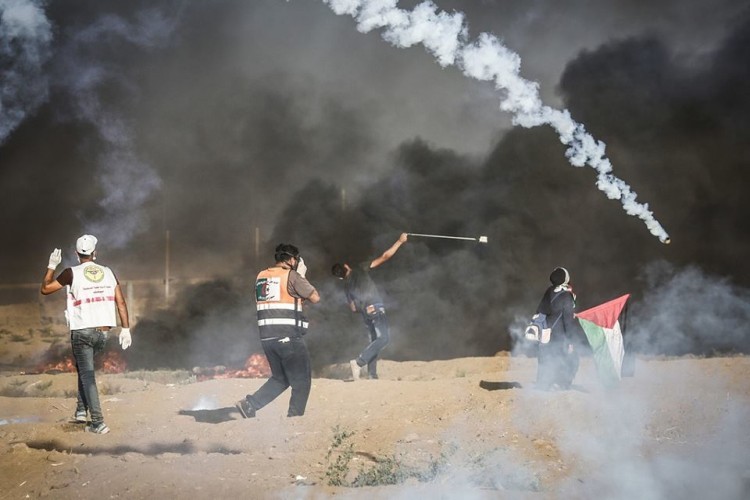
According to Gaza-based Hamas spokesperson Hazim Qasim, while "the Palestinian factions agreed that the Great Return March, which started on March 30, should be popular and peaceful", Israel "harshly targeted the peaceful protesters" and additionally struck "resistance sites and the fighters".
He told Al Jazeera: "Hamas' position was that the protests were peaceful and must remain peaceful, so Hamas decided not to let the occupation turn the protests [not] peaceful. Therefore, it decided that any military attack must have a military response".
"Despite the huge power gap between Hamas and Israel", Qasim added, "Hamas, along with the other factions, were able to establish this deterrence equation".
But did the summer mark a significant shift in tactics by Hamas?
For Tareq Baconi, Palestinian scholar and author of Hamas Contained: The Rise and Pacification of Palestinian Resistance', these events, in fact, reflected a longer-standing policy of deterrence adopted by Hamas and other factions, who "for the most part, have responded to Israeli assaults with rocket fire".
"If there was a shift in Hamas' resistance strategy", Baconi told Al Jazeera, "it was most palpable over the course of the Great March of Return - it was during this period that Hamas held back; there was not a single rocket fired over the official six weeks of protests, up to Nakba Day."
Naim described the Great March of Return - which was not initiated by Hamas, but attracted its support - as "a message for the Israelis and international community that, despite having the capability to respond to Israeli aggression, we preferred to exhaust all peaceful ways to raise our voice against the Israeli siege".
With respect to the rounds of escalation post-Nakba Day, meanwhile, Naim told Al Jazeera that "it is clear they were only a message, with the rockets being fired into the area immediately around the Gaza Strip", as opposed to larger Israeli cities further away.
"Hamas has the ability to harm Israel, but showed great restraint, based on political responsibility towards our people," Naim added.
"I think the resistance movements here in Gaza are trying to find a balance between creating a deterrence and finding an outcome or exit for the catastrophic situation", said Hamas' Naim.
"The main idea now is that we have the capability to defend ourselves, but at the same time, we see that our moral and political responsibility is to give a chance to any political efforts by the United Nations, Egyptians, the Europeans, anyone - to improve the dire situation on the ground".
"The views and opinions expressed in this article are those of the author."

Gaza is not an aberration - Israel planned this genocide decade ago
JONATHAN COOK
An award-winning independent journalist and author.
The Released Palestinian Prisoners: Exhausted Bodies and Spirits Reaching the Sky
Tala Nasir
Write and rights activistAt the end of each week since the end of the genocide war, we eagerly await the announcement of the names of the Palestinian prisoners scheduled for release on the following day.



Nothing “started” on 7 October 2023, when Hamas broke out for a single day of the Gaza “concentration camp”. Rather, Israel found an excuse that day to breathe new life into an old story, one in which it has been slaughtering and expelling Palestinians for decades.