
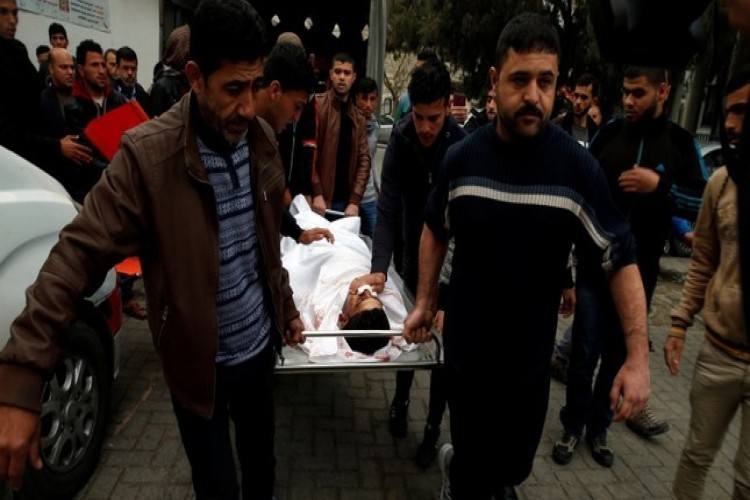
Hundreds killed, thousands wounded: A year of Gaza rallies

Ben White
a freelance writerHundreds killed, thousands wounded: A year of Gaza rallies
Palestinians to mark a year of Great March of Return protests after UN found Israel may have committed war crimes.
One-year anniversary of the Great March of Return protests, anticipating more of the same lethal violence that has characterized Israel's approach since the demonstrations began. Last month, the United Nations Commission of Inquiry (COI) published a damning indictment of Israeli forces' conduct in suppressing the protests. According to the COI, Israeli soldiers have been deliberately shooting civilians, killing and maiming protesters - including children, as well as journalists and medics. The COI's findings were welcomed by human rights groups who last year unsuccessfully challenged the army's rules of engagement and its shooting policy in Israel's Supreme Court.
Those rules permit soldiers to target so-called "main inciters" - civilians deemed to be encouraging protesters to approach the fence.
"Israel has simply invented the concept of 'main inciters,'" Professor Kevin Jon Heller, associate professor of public international law at the University of Amsterdam, told Al Jazeera.
"No such status exists under international humanitarian law (IHL) or international human rights law (IHRL). Under IHL, you are either a combatant or a civilian. Under IHRL, force of any kind requires the target to pose some kind of actual threat," Heller continued.
"You can't simply shoot someone in the leg because you think they are leading a demonstration. And lethal force requires the target to post an imminent threat to life."
Legal rights center Adalah was one of the groups which challenged Israel's response to the protests in the courts. "Israel - including the army, the government, and the Supreme Court - is recreating international law to fit its practices", said Suhad Bishara, a lawyer at Adalah who petitioned against the use of sniper fire.
"In a combat situation, IHL applies and civilians should be protected. In a law enforcement paradigm under IHRL, civilians are protected. So, what Israel has done is create new concepts that do not exist under international law to justify the killing of civilian protesters," Bishara told Al Jazeera.
As two Israeli legal experts wrote in an assessment of the Supreme Court's ruling, the government's position "conflates and obfuscates the international legal frameworks at play, creating an extremely pliable set of rules that can be manipulated depending on the exigencies of the moment".
A key part of Israel's approach to the protests is the designation of Gaza as an "enemy entity", which dates back to a September 2007 security cabinet decision.
It is this definition which "gives the green light to many illegal practices", said Bishara, whose colleagues at Adalah are currently challenging in the courts a decision to prevent any Palestinian in Gaza from seeking compensation on the basis they live in an "enemy entity".
"For the sniper, everyone on the other side of the fence is seen de facto as a threat; either you are officially affiliated to Hamas, or you are protecting them somehow. The Israeli Supreme Court categorized the demonstrators as participating in hostilities and determined that, as such, 'they lose their protection'. This is how you criminalize everyone as a potential threat - according to these broad, arbitrary, and inaccurate definitions, Israel is saying there is almost no civilian society in Gaza."
Hundreds killed, thousands wounded
According to Palestinian health officials, more than 250 Palestinians have been killed since the protests began and thousands more have been injured.
In its report, the UN found that 189 Palestinians were killed between March 30 and December 31 last year.
Israel's response to the Great March of Return protests is only the latest in a series of actions in Gaza that have drawn international condemnation.
During the 50-day offensive in 2014, for example, Israeli officials were slammed for a policy that saw Palestinian family homes repeatedly targeted over supposed links to armed faction members.
Haydee Dijkstal, an international criminal and human rights lawyer from 33 Bedford Row, told Al Jazeera that the steps taken by Israel with respect to Gaza since the 2005 withdrawal of settlers signify "a trend away from the concept of proportionality, and a retreat from protections that civilians are guaranteed under international humanitarian law".
"To categorize a whole family, groups of protesters or an entire residential area in such a way that innocent civilians could be targeted or designated as acceptable collateral damage suggests an attempt to create a justification for indiscriminate attacks and collective punishment which does not exist under international law", she added.
SOURCE: AL JAZEERA NEWS
"The views and opinions expressed in this article are those of the author."

Gaza is not an aberration - Israel planned this genocide decade ago
JONATHAN COOK
An award-winning independent journalist and author.
The Released Palestinian Prisoners: Exhausted Bodies and Spirits Reaching the Sky
Tala Nasir
Write and rights activistAt the end of each week since the end of the genocide war, we eagerly await the announcement of the names of the Palestinian prisoners scheduled for release on the following day.


Nothing “started” on 7 October 2023, when Hamas broke out for a single day of the Gaza “concentration camp”. Rather, Israel found an excuse that day to breathe new life into an old story, one in which it has been slaughtering and expelling Palestinians for decades.