
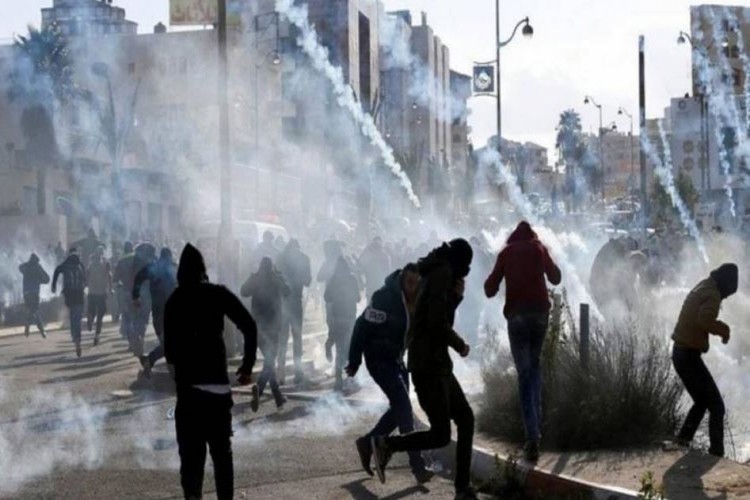
Palestinians injured during IOF suppression of West Bank marches
August 28, 2021
WEST BANK- On Friday, many Palestinian citizens were injured, after the occupation forces suppressed marches in the West Bank, rejecting the settlements and the occupation’s criminal policies.
Confrontations erupted after the occupation stormed the town of Ya'bad, during which poisonous gas bombs were fired at the homes of citizens in the "Abu Shamla" neighborhood, leaving dozens of suffocations, local sources reported.
The occupation forces intensified their military presence in the vicinity of the villages and towns of Ya'bad, Kefirt, and Arraba, erected military roadblocks, stopped vehicles, checked their passengers’ IDs, and recorded their numbers.
On Friday, two civilians were wounded by rubber-coated metal bullets, and dozens suffocated, during confrontations with the Israeli occupation forces in the town of Beita, south of Nablus.
Two civilians were wounded by rubber-coated metal bullets and treated in the field, director of ambulance and emergency at the Red Crescent in Nablus, Ahmed Jibril stated.
26 civilians were suffocated by tear gas canisters, during the confrontations in Beita, in addition to 5 others with injuries and fractures, Jibril added.
On Friday, the Israeli occupation forces quelled an anti-settlement activity in the Al-Ras area, west of the Salfit.
Tens of citizens held Friday prayers on the lands of the Ras area, renewing their rejection of the occupation’s settlement projects in the area, and stressing the land belongs to Palestinians, local sources reported.
A march was launched towards the outpost built on the lands of Al-Ras, during which the occupation soldiers fired a barrage of rubber bullets and poison gas canisters, leaving several citizens suffocated and others detained.
On Friday, the Israeli occupation forces suppressed the anti-settlement march in Beit Dajan, east of Nablus.
After Friday prayers, the march started from the center of the village towards the confiscated lands, where the occupation forces fired rubber-coated metal bullets and poison gas canisters at the civilians.
Dozens of civilians suffocated with poison gas after the occupation forces suppressed the weekly march condemning the settlements in Beit Dajan.
On Friday, the Israeli occupation forces suppressed a protest against the settlement expansion and the settlers’ repeated attacks on citizens and their properties, in Masafer Yatta, south of Hebron, and detained several Palestinian citizens and journalists.
The occupation soldiers attacked the citizens participating in the sit-in, assaulted, and detained a number of them as well as some journalists.
The occupation forces also closed the roads leading to the sit-in and declared it a closed military zone.
Hundreds of people and landowners performed Friday prayers on their lands in the "Um Al Shaqhan" area, located between the village of Al-Tuwani and Shaab Al-Butm, east of Yatta, which is threatened to be seized by "Avigal" settlers.
The occupation pursues a policy of demolishing homes, vandalizing, and razing roads, to bother the residents and pressure them to displace them from the area for the sake of expanding the settlement area south of Hebron.
The occupation seeks to displace citizens in this area by demolishing their homes and seizing their lands for the benefit of the settlements of "Carmiel", "Avigal", "Havat Avigal" and "Ma'on".
The city of Hebron suffers from the presence of more than fifty outposts in which about thirty thousand settlers live, working to strengthen the comprehensive grip on the city.
The occupation government and the settlement groups are racing against time to seize the largest amount of land possible, establish more settlements, and build roads, taking advantage of the Palestinians’ preoccupation with the Coronavirus.
Since occupying the city of Hebron in 1967 and constructing the settlement of "Kiryat Arba", the occupation has sought to turn the old city of Hebron into a settlement assisted by dividing the city into two parts by the Oslo Agreement, which put Hebron and the Ibrahimi Mosque completely under the occupation's control.
In addition, 8 civilians were wounded with rubber-coated metal bullets, and dozens suffocated with tear gas, during confrontations with the Israeli occupation forces in the town of Kafr Qaddoum, east of Qalqilya.
The occupation soldiers fired rubber-coated metal bullets, sound bombs, and tear gas at the participants in the weekly Kafr Qaddoum march, as a result of which, 8 civilians were hit, one of whom was taken to the hospital for treatment.
The gas bombs caused dozens of suffocations who were treated in the field. The occupation forces targeted an ambulance with metal bullets, which shattered its rear window.
It is noteworthy that the Kafr Qaddoum march was launched in early July 2011, calling for the opening of the village street, which was closed by the occupation during the Al-Aqsa Intifada in 2003, and to this day it continues to take place two days a week.
Kafr Qaddoum's weekly march against the wall and settlement, calling for the opening of the main street to the village, which has been closed for 18 years, continues.
The importance of the closed village entrance is that it is the corridor that connects Kafr Qaddoum and its surrounding Palestinian villages and towns, which has caused great suffering to the citizens.
Every Friday and Saturday, marches condemning the settlements are launched in different areas of the West Bank, and the participants perform Friday prayers on the threatened lands, amid the outbreak of confrontations during the suppression of these marches by the occupation forces.
-
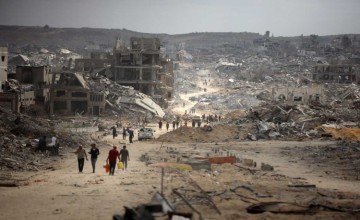
A Ceasefire of Blood: Among the enemy's arrogance and the mediator's impotence, Gaza bleeds again
-
On International Quds Day, Al-Qassam Brigades hails the steadfast Iranian Resistance
-
Abu Obaida Salutes Lebanon’s Resistance and Calls for Ummah Unity
-
Al-Qassam mourns martyrdom of Islamic Revolution's Leader, other senior leaders
-
Gaza Death Toll Surpasses 72,000 as Health System Nears the Brink of Collapse
- Abu Obaida says captives and remains were handed over under complex conditions
- Hamas condemns starvation, repression, and torture of Palestinian prisoners
- Abu Obaida, Icon of resistance media, its thunderous voice
- Al-Qassam Mourns Its Chief of Staff and a Group of Senior Leaders Killed in Combat
- Remembering 2008 Israeli occupation's offensive against Gaza Strip